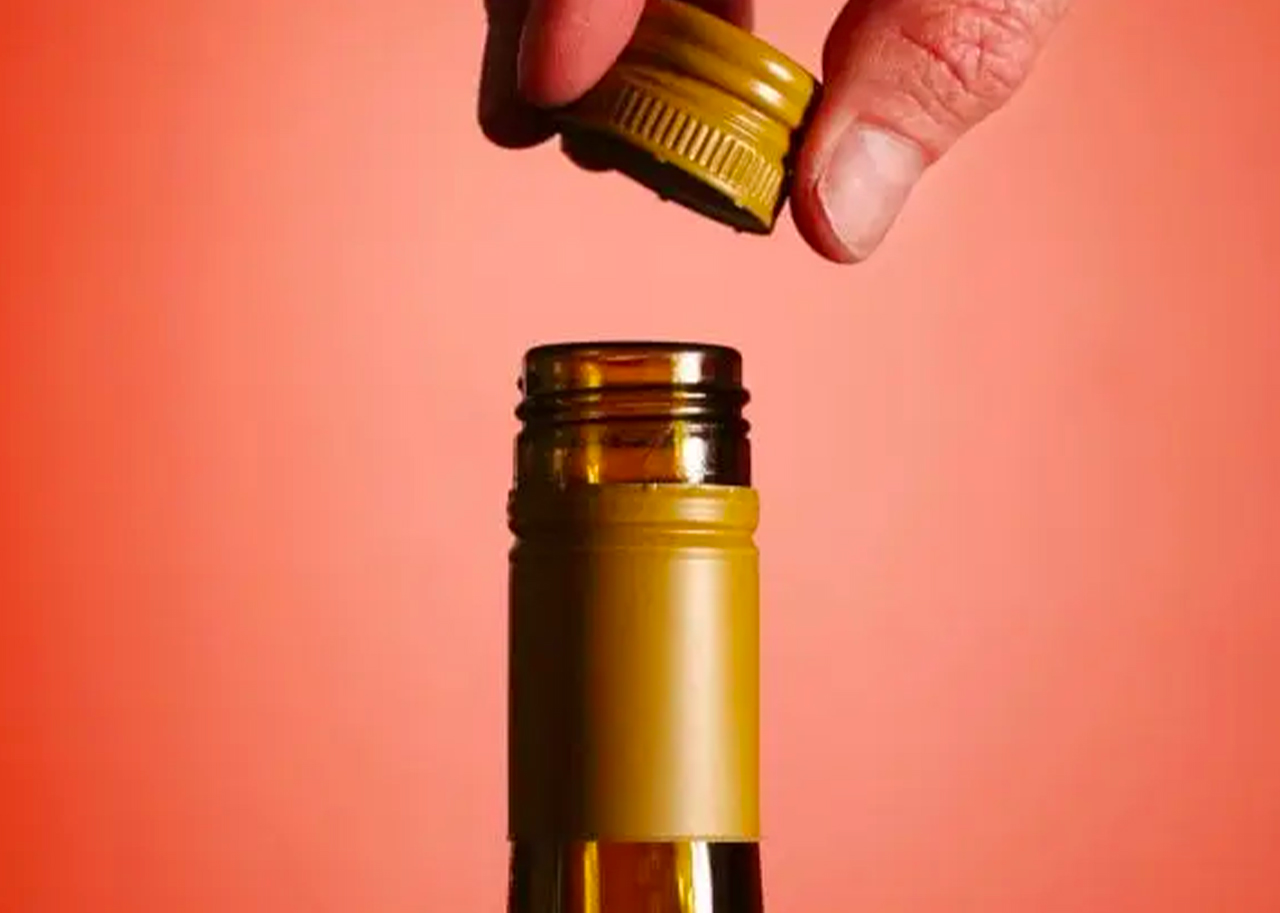
Here in Italy, there is a growing awareness of the positive aspects of the screwcap, also so-called Stelvin, after the name of the company that first produced it. Indeed, it is becoming increasingly popular as a sustainable closure, one that has all the right features to preserve, protect and evolve wine. Although Italy is a very traditional country when it comes to wine culture and bottle opening romance, there has recently been a growing demand for the screw cap closure, especially from the side of foreign markets. Convenience, practicality, sustainability, and above all, the elimination of cork defects are the most crucial benefits.
This has been scientifically proven in a study conducted since 1999 by the AWRI, the Australian Wine Research Institute, which analyzed the evolution of a wine sealed with 14 types of closures: two corks, two technical corks, nine synthetic corks, and a screwcap. The experiment, after just about three years, revealed strong positive correlations between the amount of sulfur dioxide retained in the wine, the freshness of the fruit, and the absence of color darkening. In this regard, the screwcap demonstrated superior performance compared to other closures, specifically in terms of all three parameters (SO2 retention, fragrant fruit, and maintaining a clear color).
Wine oxidation occurs when the closure is not hermetically sealed. Cork has an elastic structure, but if it is in an environment with the right humidity, it becomes damaged. In excessively dry environments, or if the wine lacks contact with the cork, the cork begins to dry out, reducing its volume just enough to allow excessive air to enter. This air then oxidizes the wine, permanently altering its flavor (which is why it is recommended to store bottles horizontally by the way). Micro-oxygenation is benefical for wines intended for long ageing, although too much air will ruin even the best wine ever.
Cork taint (due to the presence of a substance called TCA or trichloroanisole in the cork, whose odor resembles mold) still affects a significant percentage of bottles, an estimated average between 5-7%. And proponents of the screw cap also highlight the environmental aspect: to make cork stoppers, the cork must be harvested from trees, and this process is not always entirely sustainable, despite producers’ efforts to minimize its impact on the plants. That said, we come to the technical aspect: while aluminum stoppers can hardly compete with cork ones in terms of appeal, they do more than perform well. Its neutrality makes it reliable in preserving the wine’s quality, and thanks to technology, even what until a few years ago seemed to be the screw cap’s true limitation—the issue of wine evolution—has now been overcome.
Inside the closure, between the bottle and the aluminum, there are membranes, called liners, a sort of internal gasket, which allow for micro-oxygenation of the wine, which can be adjusted according to the needs and enological goal. Currently, research by wineries is focused on the development of these liners, composed of polymers with a structure that allows for calculated and standardized micro-oxygenation. A screw cap, thanks to its engineered base, provides the wine with a known and reproducible micro-oxygenation. These characteristics and guarantees are convincing more and more producers to adopt the screw cap, which is also more economical.
A choice that fully convinced us for the Etna Bianco, a wine that will be able to maintain excellent aromas of freshness but over all, ageing for such long time. Thanks to the screw cap, its integrity will be even more assured!